About
Time-aware search for humans and AI agents.
Founders

Jaedon Munton
Co-founder, CEO
Jaedon has led partnerships and worked as a forward-deployed engineer at Britain’s leading AI inference lab, getting multi-billion-token enterprise workloads running. Previously, he was a software engineer at a US venture advisory firm, where he built an investor-matching engine used by 85+ fundraising companies, and led OEM partnerships at ChipHub, pitching to Meta and Apple while building search for semiconductor datasheets. He began in product at Certie and venture at MENA-based Spartech Ventures while studying economics at Nottingham.
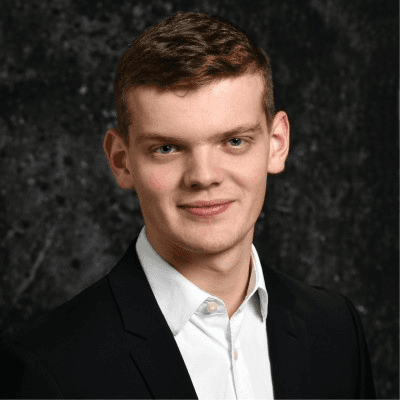
David Heinzen
Co-founder
David is a co-founder of Flux, working across strategy, go-to-market and operations. Before Flux, he co-founded a B2B software company focused on digitising psychological assessment and reporting workflows and worked at German venture capital firm D11Z Ventures on strategy, communications and AI-driven workflows. His background spans early-stage company building, venture investing and applied work at the intersection of technology and business.
Thesis
A search engine designed for change.
Information gains and loses relevance in hours. Some facts are evergreen, like a birth date. Most are not. Reality is continuously measured, interpreted, and contested by billions of people from different perspectives, so what is “true” is often something that has to be continually re-established.
Now add billions to trillions of agents generating information at machine speed. The search problem compounds: there is more to discover, more to reconcile, and more to verify - and less time in which to do it.
At the same time, verification has an economic limit. As models become more capable, inference costs remain significant, particularly for systems that spend large numbers of reasoning tokens on difficult questions. Every answer therefore has a verification budget: how many sources can be checked, how many perspectives can be compared, and how deeply can each claim be investigated? Under those constraints, systems are naturally pulled toward the information already available to them, increasing the risk of stale, incomplete, or biased answers.
Meanwhile, the ability to manipulate information is becoming more scalable and more automated. As agents gain more tools to generate, amplify, and coordinate information, the systems tasked with verifying it need to scale accordingly.
We believe one important counter-lever is parallelisable verification: using many relatively inexpensive processes in parallel to expand the breadth of what can be checked, while reserving deeper reasoning for the claims and questions where it adds the most value. In this model, verification does not have to choose between breadth and depth. It can scale breadth through parallelism and spend depth selectively.
Our broader thesis is that search should help people navigate an information environment that is increasingly dynamic, abundant, and cognitively demanding. Better search is not simply about retrieving more information; it is about making information more useful, reducing the burden of keeping up with change, and giving people and machines better foundations for meaningful work, discovery, and progress.
2D
Links on a page
Existing engines organise the web well, but most indexing and retrieval was designed before information was created at this volume and this speed. Legacy search returns links and leaves the reading to you.
3D
Agents, at machine speed
Agentic searches
will outnumberhave surpassed human ones. A model issues hundreds of queries and reads the results faster than any person, and then loses track of where a fact sat in time: who holds an office now, whether advice was accurate when it was written.4D
The web, organised by time
We crawl constantly to stay current, and organise the world by how it changes: what is evergreen, what was true for a period, how long it holds and when it is likely to move. At fragment level, orders of magnitude smaller than a full document, with granular provenance attached.
A way to organise the past and find what is next, now.
Contact
Flux Search Ltd, registered in England and Wales, company 16629567. A UK subsidiary of o7 Holdings Inc., a Delaware registered entity.